
-

A Vexing Case: A Newly Discovered Autoinflammatory Disease
Ashley Edwards, MD and Caroline McCulley, MD
Introduction: Vacuoles, E1 enzyme, X-linked, autoinflammatory, somatic (VEXAS) Syndrome is a recently recognized adult-onset autoinflammatory disease that can lead to potentially lifethreatening multi-system inflammation with estimated prevalence of up to 1 in 5,000 males over the age of 50. Given its significant morbidity and mortality and high prevalence, increased awareness of this condition is of foremost importance. Herein we outline a case of VEXAS syndrome. Case Presentation: Mr. N is a 73-year-old male with a past medical history significant for hypertension and recent episode of uveitis who first presented to the hospital for significant unintentional weight loss, fevers, and abdominal pain. Two weeks later he presented to the ED again due to recurrent fevers, nausea, vomiting, sore throat, and eye pain. Given this multi-system inflammatory disease of unclear etiology, VEXAS syndrome was considered. The UBA1 genetic test was obtained and positive, confirming the diagnosis. He was started on high dose of steroids with a slow taper and remains in remission on 5mg of prednisone daily. Discussion: VEXAS syndrome has a broad phenotype and can masquerade as multiple inflammatory and hematological conditions. The differential diagnosis is nj8broad and includes malignancy, infections, and autoimmune conditions. Prevalence is as high as 1/4269 men over the age of 50, with mortality rates as high as 50% within 4 years of onset. Multiple reviews suggest that VEXAS ought to be heavily considered in men >50 years old presenting with multisystem inflammatory disease with hematological abnormalities. Common presenting symptoms include: • Noninfectious fever • Unintentional weight loss • Dermatological manifestations • Pulmonary infiltrates • Chondritis • Macrocytic anemia Diagnosis and Treatment: Bone marrow biopsy typically demonstrating myelodysplastic changes and vacuolization of myeloid precursors. Identification of the UBA1 genetic mutation is necessary for diagnosis. Initial treatment is high dose steroids. Consider IL-6 inhibitor biologic therapy if unable to taper off Prednisone. Patients are typically co-managed by rheumatology and hematology
-
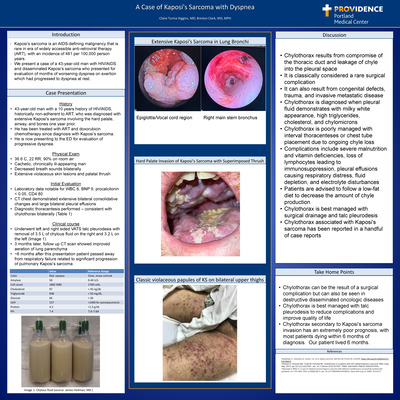
A Case of Kaposi's Sarcoma with Dyspnea
Claire Higgins, MD and Brinton Clark, MD, MPH
Introduction: Kaposi’s sarcoma is an AIDS-defining malignancy that is rare in era of widely accessible anti-retroviral therapy (ART), with an incidence of 481 per 100,000 person years. We present a case of a 43-year-old man with HIV/AIDS and disseminated Kaposi’s sarcoma who presented for evaluation of months of worsening dyspnea on exertion which had progressed to dyspnea at rest. Case Presentation: •43-year-old man with a 10 years history of HIV/AIDS, historically non-adherent to ART, who was diagnosed with extensive Kaposi's sarcoma involving the hard palate, airway, and bones one year prior. •He has been treated with ART and doxorubicin chemotherapy since diagnosis with Kaposi’s sarcoma. •He is now presenting to the ED for evaluation of progressive dyspnea. Discussion: •Chylothorax results from compromise of the thoracic duct and leakage of chyle into the pleural space •It is classically considered a rare surgical complication •It can also result from congenital defects, trauma, and invasive metastatic disease •Chylothorax is diagnosed when pleural fluid demonstrates with milky white appearance, high triglycerides, cholesterol, and chylomicrons •Chylothorax is poorly managed with interval thoracenteses or chest tube placement due to ongoing chyle loss •Complications include severe malnutrition and vitamin deficiencies, loss of lymphocytes leading to immunosuppression, pleural effusions causing respiratory distress, fluid depletion, and electrolyte disturbances •Patients are advised to follow a low-fat diet to decrease the amount of chyle production •Chylothorax is best managed with surgical drainage and talc pleurodesis •Chylothorax associated with Kaposi's sarcoma has been reported in a handful of case reports
-

Case Study: A Severe Presentation of Chronic Eosinophilic Pneumonia
Revati Kalluri, MD and Mari Kai, MD
-

From Dormant to Dangerous: Hepatitis B Reactivation Under Immunosuppression
Adam Knott, MD and Amy Dechet, MD
-

Myth of the Pentad: Approaching Thrombotic Thrombocytopenic Purpura
Nidhi Patel, MD; Meera Jain, MD; and Natasha Edwin, MD
-

Characterization of Sarcoidosis at a Combined Rheumatology- Pulmonary clinic
Megan Schermerhorn, MD and Julianna Desmarais, MD
-

A potentially cat-astrophic missed diagnosis: Systemic autoimmune disease, or something more sinister?
Cameron Smith, DO, MPH and Amy Dechet, MD
-

Endocarditis Prophylaxis in the Vulnerable Valve; Antibiotic Stewardship or Suboptimal Care?
Zachary Taylor, MD; Andrea Roast, MD; and Michael Layoun, MD
-

The Differential Expands: Ataxia from Paraneoplastic Cerebellar Degeneration
Dominic Thomas, MD and Amy Dechet, MD
-

From Hormones to Pancreatitis: A Case of Estrogen-Induced Hypertriglyceridemia
Kyaw Zin (Kennis) Htet, MD; Michael Lefor, MD; and Brinton Clark, MD
Printing is not supported at the primary Gallery Thumbnail page. Please first navigate to a specific Image before printing.