
-

Clinician Education to Promote Methicillin-resistant Staphylococcus Aureus (MRSA) Nucleic Acid Amplification Test (NAAT)-Guided De-escalation
Taylor Beauchamp, Greg Tallman, and Emily Fox
Anti-MRSA agents are commonplace in many empiric antimicrobial regimens. However, prolonged use of these drugs is associated with significant drug toxicities and development of resistant organisms such as Vancomycin-resistant Enterococci. In recent retrospective studies, the MRSA NAAT, traditionally used in pulmonary infections, has also demonstrated a strong concordance with cultures and high negative predictive value (NPVs) in a variety of other infection sites. However, in practice, clinicians often restrict the use of MRSA NAAT to pulmonary infections. Though it often takes years for research evidence to be integrated into clinical practice, lack of awareness about the broad utility of the MRSA NAAT may also contribute to its underuse. Providing comprehensive education to clinicians could translate into changes in prescribing habits and subsequently, changes in acute kidney injury (AKI) rates, length of stay (LOS), time to de-escalation and in-hospital mortality. The goal of this study will be to determine the impact of clinician education on utilization of negative MRSA NAAT results for non-pulmonary infections. This is a quasi-experimental pre/post-intervention study approved by the Institutional Review Board. The electronic medical record system was used to identify patients aged 18 years and older admitted to a Providence Oregon hospital between May 01, 2021 through November 30, 2023. Patients were included if they had a negative MRSA NAAT and received IV vancomycin treatment. Patients admitted from May 01, 2021 through May 2, 2023 will be considered pre-intervention. Patient admitted May 3, 2023 through August 22, 2023 will be considered post-intervention 1, and patients admitted August 22, 2023 through November 30,2023 will be considered post-intervention 2. Patients with inconclusive/positive MRSA NAATs were excluded. The primary outcome of this study is to evaluate the frequency of vancomycin de-escalation within 24 hours of a negative MRSA NAAT before and after providing education to clinicians on the utility of the MRSA NAAT. Secondary outcomes include evaluating the length of stay (LOS), Vancomycin acute kidney injury (AKI), IV vancomycin days of therapy (DOT standardized per 1,000 patient-days), time to de-escalation, and in-hospital mortality for patients based on the presence MRSA NAAT-guided de-escalation. Two-way ANOVA tests will be performed to assess differences between pre and post frequencies of early vancomycin de-escalation. Learning objectives: Evaluate the effect of clinical education on the frequency of early MRSA NAAT-guided de-escalation of vancomycin. Presentation category: Infectious disease
-
Safety of Linezolid Administration in Patients Receiving Serotonergic Medications
Nyda Ouch, Emily Fox, Greg Tallman, and David Chen
Background: Linezolid is an oxazolidinone antibiotic with activity against gram positive organisms, including methicillin-resistant Staphylococcus aureus (MRSA). However, the use of linezolid has been limited due to concerns for drug interactions and the risk of precipitating serotonin syndrome. There is a growing body of retrospective evidence that suggests that the risk of serotonin syndrome in patients receiving linezolid and serotonergic agents is extremely rare. This study will assess the incidence of serotonin syndrome in hospitalized patients receiving linezolid with or without a concomitant serotonergic agent. Methods: This is a multicenter, retrospective cohort study of patients hospitalized at one of the eight hospitals within Providence St Joseph Health System in Oregon between January to October 2023. Patients were included if they were at least 18 years of age and received linezolid during a hospital admission. The comparator groups were patients receiving linezolid monotherapy and patients receiving at least one dose of a serotonergic agent within 24 hours of linezolid administration. The primary outcome was the incidence of serotonin syndrome. The secondary outcome will be in-hospital mortality. The presence of serotonin syndrome was determined by physician-diagnosed serotonin syndrome or was considered a likely diagnosis of serotonin syndrome using the Hunter criteria and Sternbach criteria. Electronic medical records were searched for terms related to the presence of serotonin syndrome including serotonin syndrome, clonus, myoclonus, tremor, hyperreflexia, hypertonic, agitation, shivering, incoordination, fever, diaphoresis, incoordination, and all results related to serotonin. Results: Research in progress, data analysis will be finalized in April 2024 (IRB approved).
-
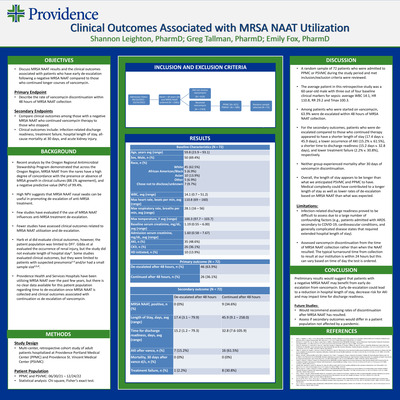
Clinical Outcomes Associated with MRSA NAAT Utilization.
Shannon B. Leighton, PharmD; Emily Fox; and Greg Tallman
Abstract: A recent analysis by the Oregon Regional Antimicrobial Stewardship Program demonstrated that across the Oregon region, MRSA NAAT from the nares have a high negative predictive value (NPV) of 99.4%. These findings were consistent when stratified by culture site. The high NPV suggests that MRSA NAAT nasal swabs can be useful in promoting de-escalation (e.g., discontinuation) of anti-MRSA treatment. Few studies have evaluated if use of the MRSA NAAT influences anti-MRSA treatment de-escalation, and even fewer have assessed important clinical outcomes related to MRSA NAAT utilization and de-escalation. The goal of this study is to evaluate the frequency of early anti-MRSA therapy discontinuation, and clinical outcomes associated with early de-escalation of anti-MRSA therapy following MRSA NAAT results. This is a multi-center, retrospective cohort study of adult patients hospitalized at one of the eight hospitals within Providence St. Joseph Health System in Oregon between June 30th 2021 and December 24th 2022. Patients were included if they had an MRSA NAAT result during admission, received at least one dose of vancomycin for anti-MRSA treatment and were > 18 years old. Patient were excluded if they had a severe penicillin or cephalosporin allergy that precluded the use of MSSA-directed therapy or were on vancomycin for pathogens other than MRSA. The primary outcome of this study is to describe vancomycin use patterns among patients with MRSA NAAT results. The secondary objective is to assess clinical outcomes among patients who have early de-escalation of vancomycin after MRSA NAAT result compared to those with longer courses of vancomycin. Clinical outcomes include infection-related discharge readiness, treatment failure, hospital length of stay, all-causses mortality at 30 days, readmission within 30 days and acute kidney injury. We will summarize the final data set using descriptive measures such as proportions, means and standard deviation, and/or medians and interquartile ranges. We will present incidence rates for the analyses of the primary outcome of vancomycin de-escalation. Clinical outcomes between groups with early vs late/no de-escalation will be initially compared using Chi square and Fisher’s exact tests, as appropriate. To adjust for potential confounders, exploratory analyses using logistic and/or Cox proportional hazards regression will be performed. For the secondary outcomes, we will summarize the final comparative data by performing a logistic regression analysis. Results and Conclusions will be shared when the project is completed. (IRB approved). Learning Objectives: Discuss MRSA NAAT results and the clinical outcomes associated with patients who have early de-escalation following a negative MRSA NAAT compared to those who continued longer courses of vancomycin. Presentation Category: Acute internal medicine/general pharmacotherapy, Infectious Disease, Medication safety/quality improvement
-
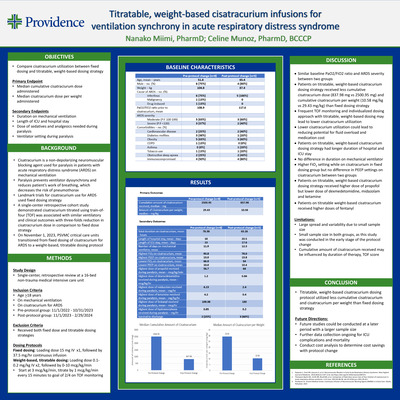
Titratable, Weight-Based Cisatracurium Infusions for Ventilation Synchrony in ARDS
Nanako Miimi, PharmD and Celine Munoz
Abstract: Cisatracurium is a non-depolarizing neuromuscular blocking agent used for paralysis in paitents with acute respiratory distress syndrome on mechanical ventilation. Paralysis prevents ventilator dyssynchrony and reduces patient’s work of breathing, which decreases the risk of pneumothorax. On November 1, 2023, PSVMC critical care units transitioned from fixed dosing of cisatracurium for ARDS to a weight-based, titratable dosing protocol. A single-center retrospective cohort study demonstrated cisatracurium titrated using train-of-four was associated with similar ventilatory and clinical outcomes with three folds reduction in cisatracrurium dose in comparison to fixed dose strategy. The purpose of this project is to evaluate the drug utilization and cost savings of the newly implemented cisatracurium dosing strategy in comparison to the previous fixed dose protocol. This is a single-center, retrospective review of patients >18 years old who received cisatracurium for ventilation synchrony in ARDS in the intensive care unit. The primary endpoint is the average dose of cisatracurium administered. The secondary endpoints include duration on mechanical ventilator, length of ICU stay, length of hospital stay, dose of sedatives and analgesics needed during paralysis, ventilator settings prior to and during paralysis, and re-initiation of cisatracurium after discontinuation. Data was collected via EPIC SlicerDicer and manual patient chart review for cases between November 1, 2022 and February 29, 2024. A total of 14 patients were assessed during pre- and post-protocol change. Results and conclusions will be shared when the project is completed. (IRB approved)
Printing is not supported at the primary Gallery Thumbnail page. Please first navigate to a specific Image before printing.