
-

Implementation of Routing CYP2C19 Pharmacogenetic Testing to Guide Antiplatelet Therapy Post-Percutaneous Coronary Intervention
Stephanie Chan
A P2Y12 inhibitor with aspirin is recommended in the post-PCI setting with stent implantation. Clopidogrel requires hepatic biotransformation to generate an active metabolite which inhibits platelet aggregation however the most prominent enzyme, CYP2C19, is a highly polymorphic gene that results in wide range of responses. Poor CYP2C19 function can lead to suboptimal clinical outcomes and increased thrombotic risk but despite this variability, clopidogrel is consistently used without routine testing. The process to be implemented is routine genetic testing in patients started on clopidogrel to optimize effectiveness and safety of their treatment while aligning with current clinical guidelines and best practices. A weekly review will be conducted to identify patients who were initiated on clopidogrel therapy. Eligible patients will be scheduled for an in-person or telephonic visit with a clinical pharmacist and during this appointment, a shared decision-making conversation will be held where patients will receive education about pharmacogenomic testing including the testing process, associated costs, and potential benefits and risks. Patients who agree to the test will undergo pharmacogenomic testing and the sample will be sent to a testing lab for processing. Once available, the pharmacist will analyze the results and provide a recommendation to the patient’s primary care provider in the form of a consult whether the patient is indicated to continue clopidogrel or switch to an alternative antiplatelet therapy with ticagrelor or prasugrel. The recommendation will be based on the patient's predicted phenotype of ultra-rapid, rapid, normal, likely intermediate, intermediate, likely poor, or poor metabolizer based on the genotype results and the current Clinical Pharmacogenetics Implementation Consortium (CPIC) guideline recommendations.
-
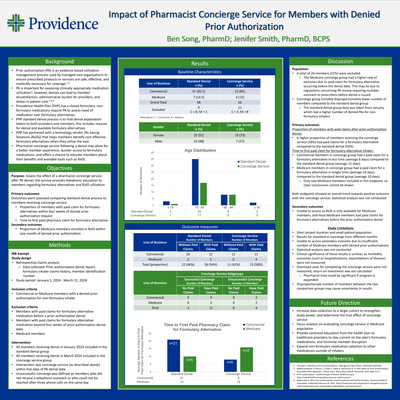
Impact of Pharmacist Concierge Service for Patient with Denied Prior Authorization
Ben Song and Jenifer Smith
Abstract: Prior authorization (PA) is an evidence-based utilization management process used by managed care organizations to ensure prescribed products or services are safe, effective, and medically necessary for coverage.2 While PA is important for assessing clinically appropriate medication utilization, however, denials can lead to patient dissatisfaction, administrative burden for providers, and delays in patient care.1,2,3 Recent studies on the effect of PA received mixed results. One study illustrated that in an American Medical Association survey about PA, 91% of physicians reported that patients requiring care experienced care delays, and 75% of patients abandoned their treatments because of obstacles associated with the PA process.4 However, another study noted that PA helped curb the opioid epidemic by requiring submission of appropriate diagnoses or attestation from multiple prescribers for duplicative opioid therapy.1 Providence Health Plan (PHP) currently has a subset of high-volume PA requests for non-formulary medications, with most of the determinations resulting in denials. With denials, PHP sends denial explanation letters to both providers and patients, including reasons for denial and formulary alternatives that would be covered. In addition, PHP has a service, Rx Saving Solutions (RxSS), that can help patients identify cost-effective formulary alternatives. However, the usage of this service is limited depending on patients’ knowledge of technology. The purpose of this project is to assess the effect of a pharmacist concierge service for PA denials, which provides telephonic education to patients regarding formulary alternatives and RxSS utilization. This project identified Commercial and Medicare patients with PA denial for a non-formulary inhaler in 2024 using PHP’s internal PA review system, health plan eligibility information, and claims history from January 2024 through April 2024. Patients were excluded if they had a paid claim for formulary medication before a PA denial. This pilot project consists of patients who were separated into two comparator groups in two separate timeframes: 1) patients not receiving concierge service (standard denial) in January 2024; 2) patients receiving concierge service within five days of the denial throughout each week in March 2024. The primary outcomes are 1) time to first paid pharmacy claim for formulary alternative; 2) proportion of patients with paid claim for formulary alternatives within two weeks of denied PA request. The secondary outcome is the proportion of Medicare patients enrolled in RxSS within one month of denied PA. Outcomes will be compared between the two groups. Results may guide future concierge service for the improvement of adherence and health outcomes. Results and conclusions will be shared when the project is completed. (IRB exempt) Learning Objectives: Describe the effectiveness of a concierge service in addition to the standard denial process of a prior authorization Presentation Category: Managed care; clinical services development; formulary management
-
Evaluation of Pharmacist Impact on Blood Pressure Metrics at Providence
Kathy Trinh, Chelsea Houshour, and Judy Wong
Abstract: PMG in the Oregon region has a strong primary care clinical pharmacy service integrated within care teams. Providers and clinic team-based workflows may refer patients to a clinical pharmacy specialist (CPS) for hypertension (HTN) management to assist in achieving blood pressure (BP) metric target of < 140/90 mmHg. BP metric data in PMG Oregon clinics are tracked in the electronic health record (EHR) within “episodes of care” (EOC) forms, which allows for pharmacist-specific data tracking. This study evaluates the impact of pharmacist-provided comprehensive medication management (PCMM) on BP metric data for all PMG clinics in the Oregon region. Secondary outcomes will evaluate the change in BP after CPS intervention(s), compare BP outcomes from overall clinic performance vs. PCMM at each PMG clinic, and compare CPS workflow models for HTN and how it impacts BP outcomes. This study is a retrospective, observational chart review of patients who received PCMM with an EOC form documented between January 2023 to October 2023. Patients are included if they are 18+ years old, established care with a PCP at PMG clinics in the Oregon region, and have a pharmacotherapy EOC for HTN documented in the EHR with clinical pharmacy services. Patients are excluded if they are on hospice or end of life care, have end stage renal disease, receiving dialysis or have a kidney transplant, pregnant, or incarcerated. Analysis of results pending. Anticipate study will demonstrate the positive impact on HTN metrics when CPS are involved in clinic workflows and managing patients collaboratively. (IRB approved) Learning objectives: • To quantify the average change in SBP and DBP (mmHg) after CPS intervention(s) for HTN management • To evaluate BP outcomes from overall clinic performance compared to pharmacist-provided comprehensive medication management for HTN at each PMG clinic in the Oregon region • To compare the different CPS workflow models for HTN and how it impacts BP outcomes Presentation Category: pharmacy practice, quality improvement
-
Development and Implementation of an Academic Detailing Service for Hypertension in in Primary Care
Emily Watt; Abby Frye, PharmD, BCACP; and Jayme Johnson
Hypertension is the number one modifiable cardiovascular risk factor and yet, remains one of the most challenging disease states to attain adequate control in. According to the National Health and Nutrition Examination Surveys (NHANES), less than 50% of adults with hypertension were considered controlled as of 2018, based on a hypertension definition of ≥ 140/90 mmHg. Academic detailing is an interactive educational outreach strategy that has been shown to improve evidence-based prescribing patterns. The objective of this quality improvement project is to develop and implement a clinical pharmacist-led academic detailing service for hypertension in a primary care setting, emphasizing improving provider knowledge in prescribing practices that have been shown to increase large-scale hypertension control rates. This objective was measured by a survey sent to prescribers before and after the detailing session that gauged knowledge and confidence in the key messages. Individual sessions with each provider were conducted to review best practice recommendations in conjunction with any areas identified for improvement in their prescribing patterns based on a brief review of their patient panel. Toolkits were developed for both the detailer and the provider. Key messages relayed during these sessions included use of single-pill combination antihypertensives, recommended follow-up and monitoring, and utility of 24-hour ambulatory blood pressure monitoring. Results and conclusions will be shared when the project is completed.
Printing is not supported at the primary Gallery Thumbnail page. Please first navigate to a specific Image before printing.