
-

QI: Improving Rates of Amblyopia Screening via GoCheck Kids Photoscreening At PMG Southeast Family Medicine Clinic
Zhong Bin Chen, Mai'ana Feuerbone, Tiffany Nguyen, and Ben Peterson
Background Amblyopia (also known as “lazy eye”) is a condition that can develop when one eye has poor vision. The brain then favors the stronger eye and ignores the input from the eye with weaker vision. This can prevent further development of the affected eye, possibly resulting in permanent vision loss. The prevalence of amblyopia in the United States is 1 to 6 percent, and considered to be a major public health problem. If left untreated, amblyopia can lead to problems in school as well as permanent vision loss in the affected eye. To avoid the effects of this disease, amblyopia must be diagnosed and treated in early childhood. Recovery of amblyopic eye is maximum when initiated before the age 3 and decreases with age. Instrument based photoscreening can be used at an earlier age than traditional visual acuity wall charts, which is advantageous for prompt referral and treatment. Photoscreeners have been studied and found to be effective in detection of amblyogenic risk factors. GoCheck kids is a smartphone-based screening tool that takes a picture of the eyes and analyzes the red light reflex for amblyogenic risk factors. Due to the increased sensitivity of the test, photoscreening is recommended by the USPSTF, AAP, and AAFP. Our clinic previously did not have any data on current rates of photoscreening as we did not have any implemented workflow. Objectives Increase rates of photoscreening with GoCheck Kids to 75% of well child checks in patients ages 12 months to 36 months by March 2025. Methods The first PDSA involved learning the GoCheck Kids (GCK) Technology, its indications, and feasibility in clinic. We learned how to use GCK and the official Providence workflow. Our QI group learned GCK independently with Provi-dence information and their website. For the second PDSA, we gave a presentation about GCK at the clinic all staff meeting. The presentation outlined the importance of amblyopia screening and when and how to utilize the GCK application. We assessed staff knowledge with a pre and post survey and also opened discussion to potential concerns with starting this workflow at our clinic. For the third PDSA, we decided to observe the Scholls Pediatrics clinic, a pediat-ric clinic that was frequently using the GCK photoscreening application and had streamlined the workflow. We were then able to adapt a similar workflow and created a visual diagram outlining specific roles for both MA’s and providers. We presented this updated workflow at the clinic all staff meeting.
-
Evaluating the Effectiveness of an Addiction Medicine Selective to Increase Resident Confidence in Treating Patients with Substance use Disorder
Kristine Park and Tanya Page
Background: Substance use disorder is a growing problem across America. It is important that primary care physicians are well trained and comfortable treating these conditions. ACGME has also prioritized this area of resident learning and increased required elective time for residents. To create better educated doctors and follow guidelines placed by the ACGME, we developed a four-week curriculum, called the addiction medicine selective, to increase resident comfort and knowledge in diagnosing and treating patients with substance use disorders in multiple settings. Methods: Analyze the effectiveness of a four-week addiction medicine focused cur-riculum with an anonymous, categorical survey that was administered to all second- and third-year residents at the beginning and end of the 2024-2025 academic year. 7 out of 14 residents completed the addiction medicine selective during this academic year. The survey included a confidence scale from not confident, slightly confident, somewhat confident, fairly confident and completely confident/fully independent regarding specific topics in diagnosing and managing substance use disorders in an inpatient and outpatient setting. Results: 11 residents completed the pre selective survey and 14 completed the post selective survey. Overall, there was an average increase of 33% in those who felt fairly confident or higher in all topics related to treating opioid and alcohol use disorder. Knowledge around community resources for patients with substance use disorder had the smallest change in response with only a 14% increase to fairly confident or higher. For the residents who completed the selective, they were all slightly confident or higher in all topics. Only residents who took the selective felt they could independently diagnose alcohol and opioid use disorder. No resident felt completely confident in outpatient treatment of alcohol or opioid use disorder. Conclusion: There was an overall increase in residents who felt fairly confident or more in treating opioid and alcohol use disorders, which can be explained by the inherent nature of residency. However, there was a noticeable increase in confidence across all topics for those who completed the addiction medicine selective. In addition, more residents felt they could independently diagnose use disorder. In general, the selective did increase resident comfort and knowledge when caring for patients with substance use disorders. However, no residents felt completely confident in treating these conditions in an outpatient setting despite completing the selective. There are several factors that make outpatient management challenging for any health condition, but we will reach out to residents to get a better understanding of this difference compared to inpatient management. There was also a knowledge gap in community resources, which we are creating a dot phrase for so that this information is readily accessible to residents. Having an understanding of the available resources may also help to improve outpatient management. There were several limitations to this study, such as small sample size and the lack of consistent identifiers for the pre and post surveys. As a result, we were unable to analyze and correlate the improvement for an individual after completing the addiction medicine selective. This should be implemented for future surveys when analyzing the effectiveness of a curriculum
-
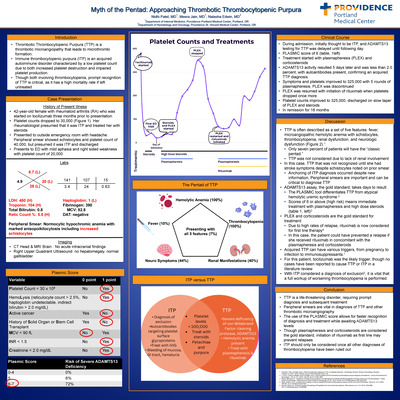
Myth of the Pentad: Approaching Thrombotic Thrombocytopenic Purpura
Nidhi Patel, MD; Meera Jain; and Natasha Edwin, MD
Introduction: •Thrombotic Thrombocytopenic Purpura (TTP) is a thrombotic microangiopathy that leads to microthrombi formation. •Immune thrombocytopenic purpura (ITP) is an acquired autoimmune disorder characterized by a low platelet count due to both increased platelet destruction and impaired platelet production. •Though both involving thrombocytopenia, prompt recognition of TTP is critical, as it has a high mortality rate if left untreated Case Presentation: •42-year-old female with rheumatoid arthritis (RA) who was started on tocilizumab three months prior to presentation •Platelet counts dropped to 30,000 (Figure 1). Her rheumatologist presumed that it was ITP and treated her with steroids •Presented to outside emergency room with headache. Peripheral smear showed schisto-cytes and platelet count of 40,000, but presumed it was ITP and discharged •Presents to ED with mild aphasia and right sided weakness with platelet count of 20,000 Discussion: •TTP is often described as a set of five features: fever, microangiopathic hemolytic anemia with schistocytes, thrombocytopenia, renal dysfunction, and neurologic dysfunction. •Only seven percent of patients will have the “classic pentad.” •TTP was not considered due to lack of renal involvement •In this case, TTP that was not recognized until she had stroke symptoms despite schistocytes noted on prior smear. •Anchoring of ITP diagnosis occurred despite new information, Peripheral smears are important and can be critical to diagnose TTP •ADAMTS13 assay, the gold standard, takes days to result •The PLASMIC tool differentiates TTP from atypical hemolytic uremic syndrome.2 •Scores of 6 or above (high risk) means immediate treatment with plasmapheresis and high dose steroids (table 1, left)2 •PLEX and corticosteroids are the gold standard for treatment •Due to high rates of relapse, rituximab is now considered for first line therapy4 •In this case, the patient could have prevented a relapse if she received rituximab in concomitant with the plasmapheresis and corticosteroids •Acquired TTP can have various triggers, from pregnancy to infection to immunosuppressants.1 •For this patient, tocilizumab was the likely trigger, though no cases have been reported to cause TTP or ITP in a literature review •With ITP considered a diagnosis of exclusion5, it is vital that a full workup of worsening thrombocytopenia is performed.
-
Evaluation of clinically non-preferred medications for the initial treatment of Type 2 diabetes within Providence Medical Group Oregon Region
Jake Turner, Pharm D; Bonnie Jiron; and Jack Huber
Abstract: Type 2 Diabetes Mellitus (T2DM) affects 1 in 10 American adults and increases a patient’s risk for developing complications, such as atherosclerotic cardiovascular disease, chronic kidney disease, and heart failure. Choosing the most optimal medications and controlling blood glucose can help prevent and/or reduce the risk of T2DM complications. Metformin has been the preferred initial agent for managing diabetes because it provides effective glycemic control, reduces the risk of microvascular complications, and lowers rates of cardiovascular-related mortality. In 2023, the American Diabetes Association recommended considering newer agents with cardiorenal and/or weight loss benefits, such as glucagon like peptide-1 agonists (GLP-1) or specific sodium glucose like transport-2 inhibitors (SGLT-2i), as preferred initial options independent of metformin use. While GLP-1, SGLT-2i and metformin are classified as clinically preferred initial treatments, it may be appropriate to use other medications as alternatives depending on patient specific factors and overall glycemic control. However, with the lack of cardiorenal risk reduction benefits and additional concerns for side effects, these agents are typically considered less preferred. There are various situations where using a clinically non-preferred medication might be suitable, although there is not much information available about the specific circumstances and reasons for this in practice. The purpose of this study is to describe prescribing patterns and rationale for the use of clinically non-preferred T2DM medications as initial therapy for T2DM within Oregon Providence Medical Group (PMG) primary care clinics. This is a multi-site, retrospective, descriptive analysis of patients who were prescribed a clinically non-preferred treatment as ini-tial therapy for T2DM between January 1st, 2023, to December 31st, 2024, either before or after the initiation of metformin. Patients to be analyzed were >18 years of age and from PMG primary care clinics in the Oregon region. Patients were excluded if pregnant, imprisoned, or being cared for at a residency teaching clinic. Epic electronic medical records were queried by a data analyst to generate a report of patients with an initial clinically non-preferred treatment for T2DM. Approximately 200 patients will be randomly selected for manual chart review to help determine the rationale for initiating non-preferred treatments along with clinical appropriateness based on patient specific factors. Descriptive statistics will be used to analyze the baseline characteristics of the study population, prescribing patterns, and rationale. Results and Conclusions will be shared when the project is completed. (IRB approved)
Printing is not supported at the primary Gallery Thumbnail page. Please first navigate to a specific Image before printing.