

Files
Download Full Text (527 KB)
Publication Date
4-30-2025
Keywords
oaa, oregon gme, ppmc gme, ppmc
Disciplines
Cardiology | Internal Medicine
Abstract
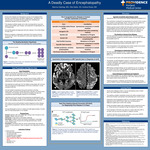
Introduction: Human prion disease are heterogenous groups of neurodegenerative disorders characterized by spongiform degeneration, astrogliosis, and neuronal loss in the central nervous system from misfolding and subsequent spread of the prion protein. This disease manifests rapidly and is often accompanied by visual and speech abnormalities, gait changes, and progressive encephalopathy. It is always fatal. Around 400 people are diagnosed with prion disease in the United States annually. Recent innovations in diagnostics using Real-Time Quaking Induced Conversion (RT-QuIC) has allowed for antemortem diagnosis of prion disease. Case Presentation: A 66-year-old male with a history of alcohol use disorder in remission and tobacco use disorder presented to the emergency department with a broken right humerus after a fall at home. He underwent a successful open reduction internal fixation (ORIF) of his humerus. His hospital course was complicated by encephalopathy and hallucinations, which improved at time of discharge. He presented one week later from his skilled nursing facility with recurrent falls and progressive encephalopathy. At the time of admission, he was oriented to self only. He had multiple complications during this admission including osteomyelitis, vancomycin indued IgA bullous vasculitis, and acute Covid-19 infection. His mentation did not improve throughout his stay and progressively declined despite treatment of comorbidities. Laboratory work-up for causes of his progressive encephalopathy were wholly unremarkable. A lumbar puncture was performed under anesthesia after all other possible causes for his encephalopathy were ruled out. His lumbar puncture demonstrated a positive diagnosis of prion disease. His symptoms progressed to akinetic mutism by the end of his hospital stay. He was discharged to home on hospice and died approximately 4 months after his initial presentation to our hospital. Discussion: Sporadic Creutzfeldt-Jakob Disease (sCJD) accounts for 85% of all human prion disease diagnosed worldwide. The mechanism is believed to be spontaneous conversion of the normal prion proteins to the pathologic variant. This may also be related to an underlying mutation that occurs in the prion gene. Patients typically present initially with falls before symptoms progress to encephalopathy and eventually akinetic mutism prior to death. The patient in this case had a very typical presentation and trajectory for sCJD (we are still awaiting final pathology results from autopsy). The Genetics of Human Prion Diseases, The prion gene sits on human chromosome 20. This is the basis of presumed genetic mutations for genetic causes of human prion disease and possible sCJD. In experimental animal models, the pathologic variants replicate in peripheral lymphoid tissue before entering the CNS. Final transportation of the pathologic prion protein travels to the central nervous system in a retrograde fashion via axons. Techniques for Antemortem Diagnosis RT-QuIC has been studied for over 10 years regarding viability for diagnosis of prion diseases and was added to the diagnostic criteria in 2018. Turn around can be quick, with results becoming available in 3-4 days. The process, as demonstrated in Figure 2, involves the seeding nucleation hypothesis. CSF is obtained by lumbar puncture and is placed in assays and tagged with thioflavin so converted proteins can be seen under fluorescence. MRI findings and EEG findings can be supportive but are not specific. 14- 3-3 protein in the CSF is also considered non-specific but is generally elevated in human prion diseases. Future Directions in Diagnosis and Treatment. Other matrixes besides CSF are being considered. Olfactory mucosa has shown similar sensitivity and specificity to CSF. Other matrixes that have been tested include muscle and skin. Treatment will remain a challenge and will likely require genetic therapy, such as CRISPR, however immunotherapies are also being explored.
Area of Special Interest
Cardiovascular (Heart)
Specialty/Research Institute
Cardiology
Specialty/Research Institute
Internal Medicine
Specialty/Research Institute
Graduate Medical Education