
-
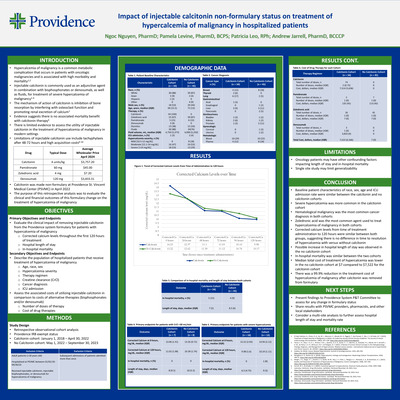
Impact of Injectable Calcitonin Non-Formulary Status on Treatment of Hypercalcemia Of Malignancy in Hospitalized Patients
Ngoc Nguyen, Pamela Levine, Patricia Leo, and Andrew Jarrell
Purpose: Evidence suggests there is limited benefit in using injectable calcitonin for the treatment of hypercalcemia of malignancy. Based on this evidence and in the setting of increased drug costs, many institutions have opted to either restrict or remove calcitonin from their formulary. The purpose of this study was to describe the patient populations receiving treatment for hypercalcemia of malignancy and to evaluate the clinical and financial impact of injectable calcitonin being removed from formulary in an acute care setting. Methods: This retrospective cohort study was reviewed by the Providence Institutional Review Board. Patients were identified through EPIC electronic medical record reports. Adult hospitalized patients (≥ 18 years old) who presented with an elevated corrected calcium level >10.4 and who received either injectable calcitonin from January 2018 to March 2022 (calcitonin group) or injectable bisphosphonates (pamidronate or zoledronic acid) or denosumab from May 2022 to September 2023 (no-calcitonin group) were included. Patients who received these agents for an indication other than hypercalcemia of malignancy were excluded. The following data were collected from EPIC reports and a chart audit: patient age, sex, ethnicity, severity of hypercalcemia, treatment indication, treatment regimen, drug treatment cost, calcium levels, albumin levels, renal function (SCr and CrCl), ICU admission and length of stay, and cancer diagnosis. Serum calcium levels, hospital length of stay, in-hospital mortality, and treatment cost were compared between the two groups. Results: Demographic data between the calcitonin and no-calcitonin groups were similar. The median age was 69 years and 72 years, and the median length of stay was 7 days and 8 days for the calcitonin group and the no-calcitonin group, respectively. In the calcitonin group, 3% of patients were admitted to an ICU admission as compared to 4% in the no-calcitonin group. In-hospital mortality was 15% in the calcitonin group compared to 8.5% in the no-calcitonin group. The most common cancer diagnosis was hematological malignancy in both groups. In the calcitonin group, the hypercalcemia severity was 0% mild, 47% moderate, and 53% severe. In comparison, in the no-calcitonin group, the hypercalcemia severity was 19% mild, 53% moderate, and 28% severe. The most common agent used to treat hypercalcemia of malignancy in both groups was zoledronic acid, with 67% use in the calcitonin group and 87% use in the no-calcitonin group.
-
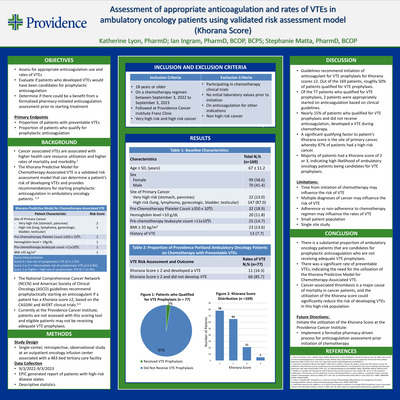
Assessment of Appropriate Anticoagulation and Rates of BTE in Ambulatory Oncology Patients using a Validated Risk Assessment Model (Khorana Scote)
David Page; Alan Su; Nikki Moxon; Staci Mellinger; Tracy L. Kelly; Katherine Lyon, PharmD; Ian Ingram; and Stephanie Matta, PharmD, BCOP
Abstract: Cancer associated venous thromboembolisms (VTE) are associated with higher health care resource utilization (number of hospitalizations, hospital length of stay, inpatient/outpatient medical services) and can complicate treatment of cancer. The Khorana Predictive Model for Chemotherapy-Associated VTE is a validated risk assessment model that determines a patient’s risk of developing VTEs and provides recommendations for starting prophylactic anticoagulation in ambulatory oncology patients. The Khorana Score is composed of various patient characteristics including site of primary cancer, prechemotherapy platelet count, hemoglobin level, prechemotherapy leukocyte count, and BMI. National Comprehensive Cancer Network (NCCN) supportive care guidelines recommend prophylactically starting an anticoagulant if a patient has a Khorana score ≥2. Currently at the Providence Cancer Institute, there is no process in place that utilizes the Khorana Predictive Model in our ambulatory oncology patients. The purpose of this clinical inquiry is to assess the current practice of VTE prophylaxis and identify the need for a system wide implementation of the Khorana Predictive Model. This is a single institution retrospective chart review of patients 18 years or older who were on chemotherapy at Providence Cancer Institute outpatient facilities from September 2022 through September 2023. Patients participating in clinical trials were excluded from this study due to clinical trials may have specific management requirements, adverse event reporting, or rules surrounding addition of other medications. Patients Reports were generated via Slicer Dicer in EPIC to identify patients with specific cancer diagnosis and BMI. Patient charts were reviewed to assess the pretreatment hematologic parameters needed to calculate Khorana scores. Rates of VTEs and compliance with NCCN VTE prophylaxis guideline recommendations were evaluated in multiple subgroups using descriptive statistical analyses. Results and Conclusions will be shared when the project is completed. (IRB exempt) Learning Objectives: Discuss the literature surrounding the Khorana Predictive Model. Describe the implications of utilizing a VTE risk assessment model in ambulatory oncology patients. Presentation Category: Anticoagulation; Hematology/oncology/ immunology/transplant; Ambulatory care/ disease state management
Printing is not supported at the primary Gallery Thumbnail page. Please first navigate to a specific Image before printing.