

Files
Download Full Text (584 KB)
Publication Date
2024
Keywords
oregon, psvmc, gme, oregon gme, oaa 2024
Disciplines
Medical Education | Pharmacy and Pharmaceutical Sciences
Abstract
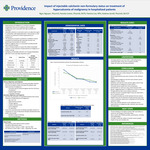
Purpose: Evidence suggests there is limited benefit in using injectable calcitonin for the treatment of hypercalcemia of malignancy. Based on this evidence and in the setting of increased drug costs, many institutions have opted to either restrict or remove calcitonin from their formulary. The purpose of this study was to describe the patient populations receiving treatment for hypercalcemia of malignancy and to evaluate the clinical and financial impact of injectable calcitonin being removed from formulary in an acute care setting. Methods: This retrospective cohort study was reviewed by the Providence Institutional Review Board. Patients were identified through EPIC electronic medical record reports. Adult hospitalized patients (≥ 18 years old) who presented with an elevated corrected calcium level >10.4 and who received either injectable calcitonin from January 2018 to March 2022 (calcitonin group) or injectable bisphosphonates (pamidronate or zoledronic acid) or denosumab from May 2022 to September 2023 (no-calcitonin group) were included. Patients who received these agents for an indication other than hypercalcemia of malignancy were excluded. The following data were collected from EPIC reports and a chart audit: patient age, sex, ethnicity, severity of hypercalcemia, treatment indication, treatment regimen, drug treatment cost, calcium levels, albumin levels, renal function (SCr and CrCl), ICU admission and length of stay, and cancer diagnosis. Serum calcium levels, hospital length of stay, in-hospital mortality, and treatment cost were compared between the two groups. Results: Demographic data between the calcitonin and no-calcitonin groups were similar. The median age was 69 years and 72 years, and the median length of stay was 7 days and 8 days for the calcitonin group and the no-calcitonin group, respectively. In the calcitonin group, 3% of patients were admitted to an ICU admission as compared to 4% in the no-calcitonin group. In-hospital mortality was 15% in the calcitonin group compared to 8.5% in the no-calcitonin group. The most common cancer diagnosis was hematological malignancy in both groups. In the calcitonin group, the hypercalcemia severity was 0% mild, 47% moderate, and 53% severe. In comparison, in the no-calcitonin group, the hypercalcemia severity was 19% mild, 53% moderate, and 28% severe. The most common agent used to treat hypercalcemia of malignancy in both groups was zoledronic acid, with 67% use in the calcitonin group and 87% use in the no-calcitonin group.
Specialty/Research Institute
Graduate Medical Education
Specialty/Research Institute
Pharmacy