
-
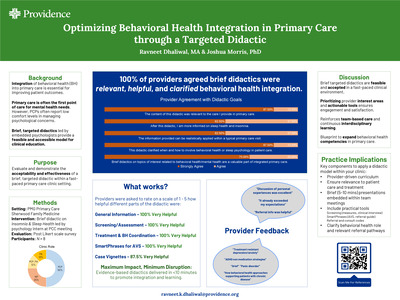
Optimizing Behavioral Health Integration in Primary Care through a Targeted Didactic
Ravneet Dhaliwal, M.A., Behavioral Health Intern and Joshua Morris
Background: The integration of behavioral health into primary care settings is an essential strategy for improving patient outcomes, increasing access to mental health services, and achieving the Triple Aim of healthcare.1, 2 To maximize this integration and bridge the gap for primary care providers (PCPs), targeted didactic training and continued education are pivotal. National surveys indicate that PCPs often report low comfort levels in managing psychological concerns due to a lack of formal training, despite the high prevalence of these issues in primary care. 3, 4 Brief didactics facilitated by embedded behavioral health psychologists offer an accessible, adaptable method for disseminating evidence-based information.1 However, the success of this model hinges on its feasibility within a busy clinical environment and its acceptability to the providers. Method: This quality improvement project implements a targeted didactic on sleep health, a topic identified as a high-priority interest in a preliminary provider survey at PMG Sherwood Family Medicine. The 10-minute didactic will be delivered during a scheduled monthly provider meeting to minimize disruption to clinical workflows. Following the presentation, providers will complete a brief satisfaction survey assessing the relevance of content and satisfaction. The researcher will qualitatively evaluate the feasibility of this delivery model and the barriers to implementation. Anticipated Results: It is anticipated that the targeted didactic will be rated moderately to highly acceptable and relevant to primary care practice. Expected outcomes include high provider satisfaction and a stated interest in future didactics tailored to clinic-specific needs. Qualitative results are expected to highlight the value of having embedded behavioral health experts to provide "on-the ground" specialty training that is relevant and applicable to patient care and barriers. Conclusion: This project plans to demonstrate that brief, evidence-based didactics are an effective method for enhancing behavioral health integration in primary care. By addressing specific provider identified interest areas, such as sleep health, embedded psychologists can foster a culture of continuous learning and interdisciplinary collaboration.5 Future iterations of this model could serve as a blueprint for expanding behavioral health competencies across diverse primary care teams, ultimately contributing to more holistic patient care and improved population health outcomes.
-

Developing an Adaptable Intake Form for the Lifespan to Optimize Efficiency of The Initial Behavioral Health Session in Primary Care
Helen Youssef, MA
Behavioral health intake forms play a key role in collecting background information necessary for comprehensive assessment and successful treatment planning. However, at Providence Gateway Family Medicine, a standardized behavioral health intake form is not currently in use because available forms are not developmentally appropriate for child populations and do not adequately capture developmental information for children and adolescents. As a result, clinicians rely on in‑session questioning to obtain essential background details, which may limit efficiency and reduce the time available to address presenting concerns. This quality improvement project seeks to address this gap via adapting a behavioral health intake form to be effective across the lifespan, with particular attention to the needs of children and adolescents. The revised intake form includes an additional section that further explores child development, school status, and family dynamics. The goal is to create a standardized intake tool that supports both behavioral health providers in delivering developmentally informed patient care. To evaluate the adapted intake form, two behavioral health clinicians at the Providence Gateway Family Medicine clinic will pilot it during new intake sessions with patients aged 17 years or younger. The clinicians will evaluate the form's productivity and clinical effectiveness. That evaluation will consider the intake form’s usefulness in gathering pertinent background information, its impact on session efficiency, and its ability to support meaningful clinical discussions. The clinicians' feedback will guide evaluation of the form’s effectiveness and inform possible improvements prior to wider implementation. This project aims to improve the intake workflow, enhance cross-disciplinary collaboration, and support high‑quality behavioral health care for children and families at the Gateway clinic.
-
Suicide Risk Assessment and Safety Planning: Exploring Provider Perceptions of a New Suicide Screening Process in a Pediatric Healthcare Setting
Darcy Gist Zornes, PsyD and Tyson Payne, PsyD
In the United States, suicide is the 2nd leading cause of death for youth ages 10 to 24, and suicide attempts and suicidal thoughts are even more common. Early detection is key to prevention, and given that the majority of people who die by suicide visit a healthcare provider months before their death, healthcare settings play an important role in early detection and prevention efforts. In 2026, Providence Children's Development Program introduced a suicide risk screening process to help identify youth who are at risk for suicide and to systematically guide providers in supporting youth and their families through safety planning and crisis interventions. The present project will explore provider perceptions of this new suicide screening protocol with the aims of (1) identifying strengths and limitations of the current workflow and (2) informing potential changes for improvement as well as applications for adaptation to other pediatric healthcare settings
Printing is not supported at the primary Gallery Thumbnail page. Please first navigate to a specific Image before printing.