

Files
Download Full Text (960 KB)
Publication Date
4-29-2026
Keywords
oregon, milwaukie, oregon gme, milwaukie gme, milwaukie oaa
Disciplines
Family Medicine | Medical Education
Abstract
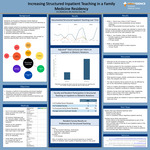
Background: What is not measured cannot be improved. Residents at Providence Milwaukie Family Medicine Residency identified a need to increase structured teaching on inpatient rotations. Other projects aimed at increasing structured teaching during family medicine training have demonstrated improvements in resident confidence in key areas of practice, licensing exam performance, and resident satisfaction with their training. However, without a system of measurement, the number of teaching opportunities cannot be reliably improved. Objectives: Develop a method of documenting structured inpatient teaching that occurs at Providence Milwaukie Hospital. Then, implement interventions using a quality improvement model to increase structured teaching over time. Methods: A list of inpatient topics was developed referencing inpatient curricula from UCSF and Johns Hopkins. This list was narrowed down to 30 common admitting diagnoses and 10 “common pages” using feedback from the residency inpatient committee. A table was shared on the residency inpatient SharePoint where interns could document who taught them each topic. Then, three PDSA cycles each lasting 4 months aimed to increase the rate of documented teaching over time. Results: The baseline rate of intern-documented structured learning activities during inpatient rotations over the final 4 months of the class of 2027 intern year was 3 per month. This includes the first PDSA, where interns were oriented to the spreadsheet during resident meetings. With this baseline data, a target was selected to improve the number of documented structured learning activities to 4 per month by the end of the subsequent academic year. After providing a space to share teaching materials in the SharePoint, the rate of teaching for the first 4 months of the class of 2028 intern year increased to 3.75 per month. After asking general surgery to teach sessions, the rate of teaching for the subsequent 4 months remained stable at 3.8 per month. Discussion/Conclusions/Next Steps: This project was successful in producing a method of documenting structured inpatient teaching that interns receive in a family medicine residency. Quality improvement efforts were successful in generating a ~25% increase in teaching rates, with the most effective intervention being sharing a space for teaching resources. Comparing adjusted teaching rates on inpatient to obstetric rotations demonstrates a continued discrepancy (5.5 vs 14 per month). This highlights the imbalance that residents experience in their education and reaffirms the need for continued efforts at improving structured learning in the inpatient setting. Future efforts could consider posting the list of teaching topics in the resident workroom, adding teaching topic selection to the list of to-dos on the senior inpatient guide, and engaging faculty to improve teaching rates.
Specialty/Research Institute
Family Medicine
Specialty/Research Institute
Graduate Medical Education
Location
Milwaukie, OR