

Files
Download Full Text (1.5 MB)
Publication Date
2024
Keywords
oregon, hood river, oaa hood river, oregon gme
Disciplines
Medical Education | Pharmacy and Pharmaceutical Sciences
Abstract
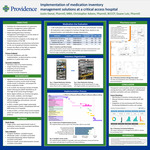
Abstract: Accurately monitoring pharmacy inventory in real-time is vital to providing safe and cost-effective medical care at hospitals of any size. At smaller critical access hospitals, in particular, effective inventory management requires solutions to unique problems posed by floorspace, budget, and workflow limitations. In 2022, Providence Health System (PHS) began systemwide implementation of both a standardized inventory management solution (IMS) and an AI-assisted medication ordering software (MOS). By initiation of this project, larger hospitals in the system had already implemented the IMS and MOS at their inpatient pharmacies to mixed success. In May of 2024, Providence Hood River Memorial Hospital (PHRMH), a 25-bed bed critical access hospital, will go live with these products. The purpose of this project was to facilitate the implementation of both the IMS and MOS at PHRMH. This is a single center, prospective, observational analysis of medication inventory and associated workflows at a critical access hospital. Data was collected through a review of medication orders from the wholesaler, automated dispensing cabinet (ADS) dispenses, and electronic health record (EHR) administration records spanning from 1/1/2023 to 12/31/2023. Digital records were reviewed and validated by pharmacy technicians and pharmacists at PHRMH. The primary outcome is end-user satisfaction with the IMS and MOS. Secondary outcomes include on-hand inventory value, floorspace usage, out-of-stock frequency, order processing times, and inventory turnover frequency. Tiered check-ins are being conducted three times per week to facilitate cross-team communication and shared governance in decision-making. In the preparation phase, a total of 1198 products were linked among the electronic health record (EHR), the ADS system, the wholesaler’s ordering system, the MOS, and the IMS via a standardized ADS ID. Ordering and dispensing history from 2023, including nearly 136,000 ADS dispenses, were consulted to recommend par levels for each product. The pharmacy was then separated into 10 inventory storage areas (ISAs), based on size, physical location, and medication storage requirements. Whereas monoclonal antibodies accounted for roughly half of the inventory value in the pharmacy, one refrigerator was designated as its own ISA to house these drugs, aiding future audits. Physical and digital integration of inventory with the IMS is ongoing, as the go-live is planned for May, 2024.
Specialty/Research Institute
Graduate Medical Education
Specialty/Research Institute
Pharmacy



