
Files
Download Full Text (479 KB)
Publication Date
4-29-2026
Keywords
oregon, psvmc, psvmc gme, psvmc oaa
Disciplines
Medical Education
Abstract
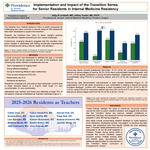
The transition from medical student to intern is widely recognized as a challenging period, and numerous curricula have been developed to support this transition. However, the transition from intern to senior resident receives far less attention despite presenting its own unique challenges. Anecdotal feedback from internal medicine residents and emerging literature suggests that the transition to senior resident is associated with feeling emotionally overwhelmed from simultaneously being a learner, leader and educator.1,2 To address this gap, the Transition Series was developed as a novel curriculum to support internal medicine residents as they advance into their senior roles. Building on the existing Intern Only series, the Transition Series emphasized leadership development, strategies for teaching, and advanced clinical skills not typically covered during intern year. By providing dedicated time for developing these skills, the curriculum aimed to enhance senior resident preparedness, confidence, and well-being in their new roles. The curriculum consisted of eight weekly 45-minute sessions at the start of the academic year, covering key senior resident competencies: team management, giving effective feedback, tools for giving and mentoring morning reports, point-of-care ultrasound (POCUS), residents as teachers, leading a debrief, and the responsible use of AI in medicine and medical education. Residents completed pre- and post-surveys rating their comfort in these domains (1 = very uncomfortable, 5 = very comfortable). Attendance was tracked, and those who attended at least 70% of the sessions received a Residents as Teacher certificate. Pre-survey results showed widespread discomfort: 37% (6/16) felt uncomfortable teaching learners at various stages, 56% (9/16) were uncomfortable managing a team, and 87.5% (10/16) lacked confidence in giving formative feedback. Additionally, 75% (12/16) were uncomfortable using POCUS for pulmonary edema, and 31% (5/16) felt unprepared to lead a debrief. Post-survey data demonstrated improvements in each domain assessed. All respondents (14/14) felt either somewhat or very comfortable in leading a debrief and giving formative feedback. Comfort with managing a team increased from 56.3% (9/16) to 85.7% (12/14), using POCUS for pulmonary edema rose from 25% (4/16) to 55.6% (5/9), and confidence in team management went from 43.8% (7/16) to 77.8% (7/9). These findings highlight the value of intentional, structured support during the intern-to senior resident transition and suggest that curricula like the Transition Series can significantly improve resident confidence in leadership, teaching, and advanced clinical competencies. Beyond the quantitative improvements, the series fostered a sense of community and validation among residents navigating their new responsibilities. A personal lesson learned through this project is the power of using lived experience to drive meaningful change and the importance of creating space for emerging educators to shape the systems they are a part of. Having just completed residency, I was uniquely positioned to prioritize topics that felt most relevant in real time. This perspective allowed me to design a curriculum that directly addressed the gaps I had experienced, and to advocate for a more learner-centered approach to resident development. Moving forward, resident feedback will be incorporated into the sessions to make them more interactive and include concise “one-pagers” to reinforce take-home points and support diverse learning styles. I also hope to broaden the scope of input by inviting perspectives from outside the residency core faculty, including subspecialists and recent graduates who have just experienced the transition. To further refine this curriculum and enhance the project’s reach, a focused needs assessment will be distributed to multiple internal medicine residency programs to better understand the challenges of this transition and refine the curriculum to meet evolving learner needs.
Specialty/Research Institute
Graduate Medical Education
Specialty/Research Institute
Internal Medicine