

Files
Download Full Text (2.0 MB)
Publication Date
4-29-2026
Keywords
oregon, ppmc, ppmc gme
Disciplines
Medical Education
Abstract
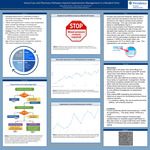
Background: Managing hypertension in ambulatory settings is becoming increasingly challenging, often competing with other visit priorities. “White coat hypertension” remains a key consideration when considering initiating or increasing anti-hypertensives. Blood pressure may be transiently elevated on initial screening and improve on recheck. Problem: In our clinic, only ~55% of patients were at goal, defined as BP < 140/90 at last office visit. • < 50% of patients received serial recheck after identifying an elevated reading. • 43% of same-day rechecks were < 140/90. Aim: Enhance hypertension management using low-cost, easy to implement interventions. Results: Process was examined iteratively, starting with a yellow card that was placed on the door to alert clinicians to the need to recheck blood pressure before discharge. This was continually refined based on staff feedback. Visual cues prompted more frequent rechecks by rooming staff, increasing the rate of those with elevated initial reading who had serial recheck from 48% to 69%, a net increase of 21%. Improvement was seen in clinic-wide blood pressure control, with the percentage of patients with a blood pressure < 140/90 at most recent office visit increasing from 55.7% to 66.6% after 1 year. This represented a net increase of 10.9%. Discussion: Visual cues in the exam room were effective at alerting clinicians for the need for serial BP recheck. These were most-effective when they were “eye catching”. PharmD visits were effective at creating a visit to focus solely on hypertension management, thereby eliminating competing interests that may dominate office visits with their primary care provider. These paired interventions were surprisingly effective at halting clinical inertia and ultimately led to more effective management of hypertension clinic-wide. Team-based EMR messaging was particularly helpful as an adjunct for coordinating timing of blood pressure rechecks. In a residency setting, this can be performed while ‘staffing’ with a faculty physician. Limitations: Current guidelines identify blood pressures >130/80 as hypertensive. This study utilizes 140/90 as a cutoff. Frequency of blood pressure rechecks highly variable based on available support staff. May place strain on support staff when short staffed. PharmD involvement may not be available in every setting
Specialty/Research Institute
Graduate Medical Education
Specialty/Research Institute
Internal Medicine